Key Takeaways
- Modern infrastructure projects require innovative engineering solutions to address complex challenges.
- Advanced technologies like AI and automation are transforming project delivery methods.
- Collaboration between public agencies and engineering firms is essential for successful infrastructure development.
Introduction
Modern infrastructure projects drive economic growth and shape the way communities live, work, and connect. The role of engineering has never been more critical in designing and implementing infrastructure that meets society’s evolving needs. Today’s successful projects rely on an intricate blend of traditional design practices and cutting-edge innovation. Among the key contributors to this landscape are land development engineers, whose expertise ensures that new communities are built with longevity, resiliency, and functionality in mind.
As the demands placed on infrastructure become more complex, engineers must anticipate not only today’s requirements but also future challenges, including population growth, environmental pressures, and technological change. This paradigm shift is pushing the industry into a new era characterized by collaboration, intelligent design, and rapid integration of emerging technologies.
Innovative Engineering Solutions
Infrastructure projects of the twenty-first century are rarely straightforward, often requiring tailored solutions that address site-specific and global challenges simultaneously. For example, the U.S. Army Corps of Engineers recently awarded a $240 million contract to Tetra Tech, underlining the importance of engineering expertise for military and critical infrastructure projects. These types of engagements reflect a larger trend in the engineering sector, where customized and innovative solutions are required to ensure safety, compliance, and operational efficiency for every development.
Innovation is not only welcomed but essential within this field. Land development engineers and architecture professionals are leveraging advances in materials science, construction techniques, and environmental planning to deliver projects that maximize value while accounting for ecological and social impacts. These professionals are uniquely positioned to bridge the gap between current regulations and the vision of sustainable urban spaces, as noted in recent reports by The New York Times DealBook.
Integration of Advanced Technologies
The integration of advanced technologies is quickly redefining what is possible in infrastructure engineering. A significant driver of this transformation is artificial intelligence (AI), which is beginning to overhaul project delivery in ways previously unimaginable. Companies like Bechtel, a global leader in construction and engineering, have recently established strategic roles focused on deploying AI and digital technologies across their project portfolios. These initiatives are rapidly boosting productivity and efficiency for stakeholders, reducing project timelines and costs while enabling more accurate predictions of potential risks and outcomes.
Automation and AI are not only supporting the design and planning phases but are also transforming construction methods. Digital modeling, real-time monitoring, and predictive analytics enable early detection, on-the-fly planning, and completion of large-scale and smaller community projects sustainably and within budget. As Wired highlights, the impact of AI and automation is only set to deepen as technology matures.
Collaborative Efforts in Infrastructure Development
Few infrastructure milestones are achieved in isolation. Collaboration between public agencies and engineering firms is the backbone of successful project development. The recent contracts AECOM secured to provide design, environmental, and project management services for Sound Transit’s ambitious expansion of the Seattle-area transit network underscore the importance of public-private partnerships. These collaborations bring together technical knowledge, funding, community input, and regulatory oversight, resulting in infrastructure that is safe, accessible, and responsive to community needs.
Multidisciplinary teams are now increasingly the norm for major infrastructure projects. Architects, engineers, planners, and construction managers often work alongside environmental scientists, technologists, and local stakeholders. This integrated approach ensures that projects are seen not just as physical assets but as pathways to a more connected and resilient future.
Case Study: Hudson River Tunnel Project
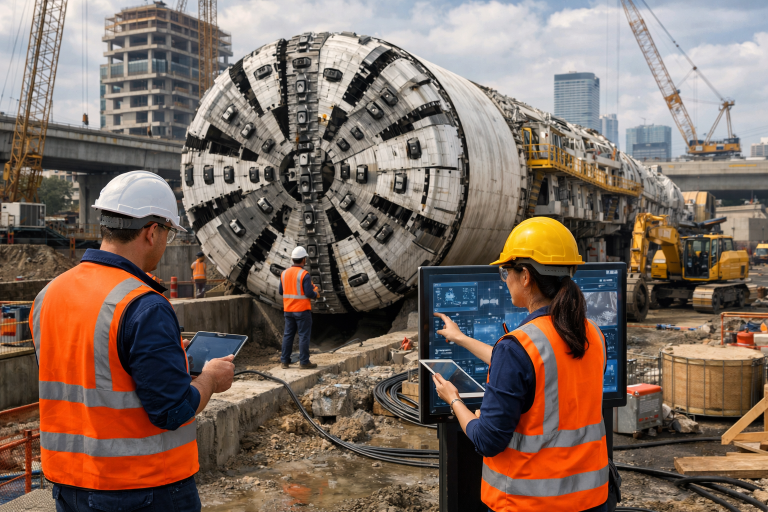
The $16 billion Hudson River Tunnel project is a striking example of modern infrastructure engineering. This initiative, which will create a new passenger train tunnel beneath the Hudson River to connect Manhattan with New Jersey, exemplifies the necessity of advanced technology and expert coordination. Massive automated tunnel-boring machines are utilized to cut through dense rock, offering unprecedented efficiency and safety compared to traditional tunneling methods. As detailed in the Wall Street Journal, the tunnel is not only an engineering feat but also a model of urban resilience, designed to withstand severe environmental events and accommodate future growth in rail traffic alongside sustainability goals.
Challenges in Modern Infrastructure Engineering
Despite significant advancements, infrastructure engineers face a suite of challenges, from rising material costs and increasingly stringent regulatory requirements to urgent demands for greater sustainability. The industry is shifting toward multidisciplinary problem-solving to address these issues. Sustainable design is no longer a buzzword but a necessity, requiring that every project component be scrutinized for environmental, financial, and social impacts. In many cases, engineers must innovate continuously to keep pace with changing standards and stakeholder expectations.
Future Trends in Infrastructure Engineering
Several key trends are shaping the future of infrastructure engineering. Advanced AI will continue to permeate every phase of project development, enabling data-driven decision-making and further automation of design and construction tasks. The adoption of sustainable and smart infrastructure concepts is set to accelerate, with features such as automated traffic management, green buildings, and energy-harvesting roadways becoming increasingly common. The engineering workforce will also evolve, with an emphasis on cross-disciplinary skills, adaptability, and innovation-driven mindsets. Emerging trends identified by Forbes point to a future in which infrastructure not only supports day-to-day life but also actively contributes to social equity and climate resilience.
Conclusion
Engineering remains at the very heart of modern infrastructure projects, driving innovation and partnerships that will define our communities for decades to come. As engineers embrace advanced technologies and collaborative frameworks, they are uniquely positioned to deliver infrastructure that supports economic opportunity, meets rising environmental standards, and fundamentally improves the quality of life for everyone.