As edge AI workloads continue to scale in complexity—from multi-camera vision systems to transformer-based inference—dedicated AI accelerators have become a critical component in embedded and industrial platforms. The M.2 form factor, with its standardized mechanical and electrical interface, has emerged as a practical solution for adding neural compute capability to both ARM-based and x86 systems.
This article presents a technical comparison of four representative M.2 AI accelerator modules currently used in edge inference deployments.
Rather than focusing on marketing specifications alone, this analysis evaluates the modules from a system design perspective, examining architecture, performance characteristics, power efficiency, software maturity, and deployment suitability.
Architectural Approaches
Although all four solutions share the same M.2 PCIe interface, their internal architectures reflect fundamentally different design philosophies.
Geniatech AIM-M2, based on the Kinara Ara-2 NPU, targets high-throughput inference with support for large and complex neural networks. Its architecture emphasizes scalability and on-module memory capacity, making it suitable for transformer-based models and multi-model workloads.
MemryX MX3 M.2 integrates multiple MX3 inference chips on a single module. This design favors parallel execution of smaller models, relying on a dataflow-centric architecture that minimizes off-chip memory access. The result is low latency for vision workloads that can be decomposed into highly parallel pipelines.
DEEPX M.2 takes a different approach, optimizing aggressively for energy efficiency. Its architecture is tuned for vision inference with streamlined data paths and tight integration with camera pipelines, prioritizing deterministic latency at very low power levels.
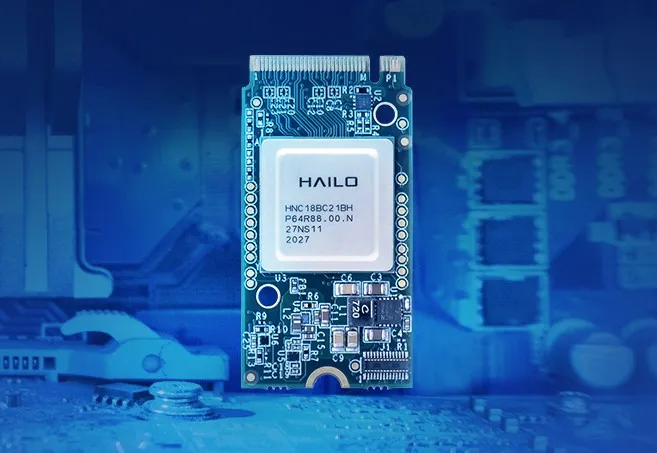
Hailo-8 M.2 adopts a balanced dataflow architecture focused on maximizing TOPS-per-watt. Rather than pushing peak throughput, it emphasizes efficient utilization of compute resources across a wide range of convolutional and detection networks.
Performance Characteristics
From a raw compute perspective, the four modules span a relatively narrow TOPS range but differ significantly in how that performance is delivered.
Geniatech AIM-M2 provides the highest peak INT8 throughput in this comparison, reaching approximately 40 TOPS. More importantly, it sustains high utilization across complex networks, including multi-head attention and transformer layers, which are increasingly common in modern edge AI workloads.
Both the DEEPX M.2 and Hailo-8 M.2 operate in the 25–26 TOPS range. While their peak numbers are similar, their performance profiles differ. DEEPX focuses on consistent frame-level latency for vision tasks, whereas Hailo-8 emphasizes throughput stability across multiple concurrent inference streams.
The MemryX MX3 M.2, with an aggregate compute capability around 24 TOPS, is optimized for workloads composed of multiple small to medium-sized models. Its architecture enables efficient batching and parallel execution, particularly in multi-camera vision systems.
In practice, the effective performance of each module depends heavily on model topology, memory access patterns, and compiler optimization rather than TOPS alone.
Power Efficiency and Thermal Design
Power consumption is often the decisive factor in edge deployments, especially in fanless or thermally constrained systems.
The DEEPX M.2 clearly targets ultra-low-power scenarios, operating typically in the 2–5 W range. This makes it well-suited for always-on vision nodes, mobile robotics, and smart cameras where thermal headroom is minimal.
The Hailo-8 M.2 offers an excellent balance between performance and efficiency, delivering strong inference throughput at relatively low power compared with GPU-based alternatives. Its TOPS-per-watt efficiency makes it attractive for multi-stream video analytics.
Geniatech AIM-M2, with power consumption around 12 W, requires more careful thermal design but compensates with significantly higher model capacity and flexibility. It is better suited for industrial PCs or embedded systems with active or well-designed passive cooling.
The MemryX MX3 M.2 typically operates in the 10–14 W range, depending on workload parallelism, positioning it between high-performance and low-power solutions.
Software Toolchains and Model Support
Software maturity often determines deployment success more than hardware specifications.
The Hailo-8 platform benefits from a well-established compiler and SDK ecosystem, with strong support for TensorFlow, PyTorch, and ONNX. Its Dataflow Compiler is particularly effective at mapping convolutional networks onto the hardware with minimal manual tuning.
Geniatech AIM-M2 software stack focuses on supporting advanced model architectures, including transformer-based networks. Its toolchain is designed for flexibility, allowing developers to deploy multiple models concurrently and scale workloads as requirements evolve.
The MemryX MX3 platform emphasizes ease of optimization, with tooling that abstracts much of the hardware complexity and enables efficient mapping of vision pipelines.
The DEEPX M.2 software environment is streamlined for vision-centric applications, integrating inference with camera and video processing workflows to reduce system-level overhead.
Deployment Considerations and Use-Case Fit
From a system integrator’s perspective, each module aligns with a distinct class of applications:
- Geniatech AIM-M2 is best suited for edge systems requiring high model complexity, such as transformer inference, multi-model analytics, or advanced perception stacks.
- MemryX MX3 M.2 excels in parallel vision workloads, particularly multi-camera systems with smaller, repeated models.
- DEEPX M.2 is optimized for ultra-low-power vision nodes, where efficiency and deterministic latency outweigh raw throughput.
- Hailo-8 M.2 provides a balanced solution for mainstream edge AI deployments, combining good performance, power efficiency, and mature tooling.
Conclusion
Although these four M.2 AI accelerators share a common physical interface, they represent markedly different design trade-offs. Peak TOPS figures alone do not capture their real-world behavior. Instead, architecture, power efficiency, software maturity, and workload alignment ultimately determine suitability.
Selecting the right module requires a clear understanding of model complexity, power budget, thermal constraints, and long-term software support. As edge AI hardware continues to diversify, such architectural differentiation within the M.2 ecosystem is likely to become even more pronounced.